Infrared LEDs are used in eye trackers, security cameras, depth
sensors, and many other devices, and properly designed systems can
use them safely and effectively. Because infrared light is invisible,
it is helpful to verify the output of unfamiliar or modified emitters.
This guide explains the factors that affect exposure and how to
evaluate an infrared setup.
To help support this software and other open-source projects, please consider
subscribing
to or joining my YouTube channel.
Understanding Infrared LED Safety
Practical exposure limits
Irradiance describes radiant power arriving at a surface per unit
area. It is commonly measured in watts per square meter
(W/m²) or milliwatts per square centimeter
(mW/cm²), and is a useful benchmark for evaluating infrared (IR) light sources.
For reference: 100 W/m² = 10 mW/cm²
IEC 62471
provides a framework for evaluating the photobiological
safety of lamps and lamp systems, including infrared sources. Per this framework, a value
of 100 W/m² (10 mW/cm²) can be useful as
a simplified screening reference for safe use, but this is not a
universal pass-or-fail limit for every IR LED.
A proper assessment depends on the emitter wavelength, exposure
duration, viewing distance, beam shape, apparent source size, and the
relevant hazard being evaluated. Consumer meters may also have
limited wavelength ranges or may respond differently to sunlight and
narrow-band LEDs. For any DIY system or product, assess the complete system
against an objective standard in repeatable conditions.
Irradiances for Common Eye Tracking Devices
For reference, I tested multiple eye-tracking devices with a Melles Griot
power/energy meter and an NIR irradiance meter to benchmark their respective irradiance in comparison with the IEC threshold. Individual LEDs were placed in front of the Melles Griot sensor aperture (1cm diameter sensor at 1cm distance), and I used the NIR irradiance meter to measure each device's complete LED array (per eye) at 3 cm. The values below represent the highest values observed during the tests. Note that the Melles power meter measures the entire light spectrum, not just NIR.
Sorted from least to greatest, with green values under the IEC threshold:
incandescent lighting
Window with UV-cut film
Meta Quest Pro
HTC Vive pro Eye
Pixel 9 flashlight min brightness (non-IR)
OV9281
Hololens 2
GC0308
GC0308 custom
Pupil Labs
IEC Limit
Pixel 9 flashlight max brightness (non-IR)
IR torch
Units
Melles Griot Power/Energy Meter @1cm single LED, 1cm diameter sensor
0.03
0.13
0.03
0.04
0.47
0.25
0.06
0.38
0.46
0.63
NA
16.18
5.2
#LEDs per eye
1
1
9
9
1
2
11
2
2
2
NA
1
8
Multiplied by # LEDS for Melles Griot
0.03
0.13
0.27
0.36
0.47
0.50
0.66
0.76
0.92
1.26
10.00
16.18
41.60
mW
All LEDs via VBNIR meter @ 3cm
0.00
0.14
0.16
0.17
0.30
0.24
0.20
0.27
0.31
0.35
10.00
18.62
12.53
mW/cm2
Though there is some variation in irradiance values, both meters produce relatively similar output values for each device, giving us practical evidence as to which devices are safe per the IEC threshold.
How to evaluate your own infrared emitter
Use an irradiance meter such as the one in the image below
to measure the device in its intended configuration, not only
the LED by itself. It is best to have a reference LED and to
test at the closest realistic viewing distance. A repeatable
measurement provides useful reassurance that the setup is behaving
as intended.
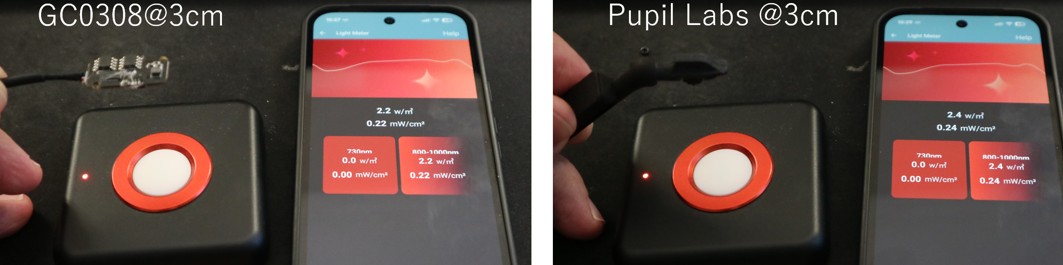
In the following image, I evaluate the pupil labs camera against
the GC0308 camera by holding both cameras directly over the meter sensor at the same distance. These were taken within one minute of each other.
Pupil labs and GC0308 irradiance measurements
How LED shape changes irradiance
The optical shape of an LED affects how its output is distributed. A
domed LED can concentrate light into a narrower beam, while a
flat-top or diffused LED spreads the output across a wider area. A
coating can diffuse it further.
At a distance of five centimeters, three LEDs powered by the same
OV9281 camera module produced the following example readings:
Domed LED:             approximately 10-15 W/m² (1-1.5 mW/cm²)
Sanded flat-top LED:   approximately 3-4 W/m² (0.3-0.4 mW/cm²)
Painted flat-top LED:  approximately 1-2 W/m² (0.1-0.2 mW/cm²)
These readings illustrate the effect of diffusion, but they do not
establish one limit for every distance or exposure duration. Diffusion
and sensible placement can help reduce concentrated output, while
moving an emitter closer to the eye increases irradiance. If you
modify an LED, measure the finished setup so you know how it performs.
Driving current helps determine output
LED output is strongly related to driving current. Two products using
visually identical LEDs can produce very different irradiance if
their circuits supply different current or use different pulse
patterns.
Checking average current, peak pulse current, and duty cycle makes it
easier to choose an appropriate emitter and compare setups. Reliable
current limiting also helps keep output predictable during use.
Key takeaway
Infrared LEDs are useful, efficient tools for eye tracking and many
other applications. Choosing a modest-output source, using sensible
distance and diffusion, and checking the complete system against a
known source with an irradiance meter can make an IR setup both
practical and reassuring to use.
This page is educational and does not replace a formal safety
assessment or professional advice.